In what has become an annual tradition for me, last weekend I photographed the NFL Draft for Sports Illustrated at Radio City Music Hall. The first time I covered it was 2001 when the number one pick was Virginia Tech QB Michael Vick.
Since the event looks similar each year, I consider it a personal challenge to try something different every time. I’ve done portraits of fans outside, set up remotes with fisheye lenses, and shot from backstage.
This year, I wanted to have a few different angles of every pick, so I set up three remote cameras all around the stage. Easier said than done, but since I’ve shot this before, I know some of the people who work at the venue. Setup went smoothly over the course of two days, but there are always some unexpected issues.
Before the show, I worked with the NFL to mark a spot on the stage where NFL commissioner Roger Goodell would stand when he met and posed with each draft pick. That allowed me to set up and pre-focus my remote cameras.
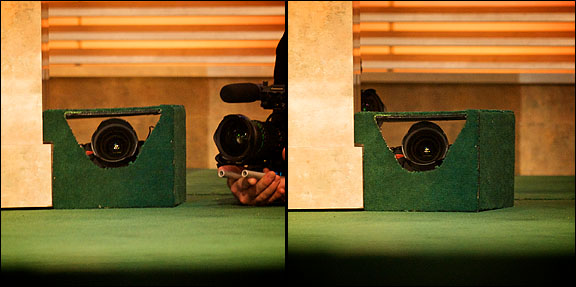
I put a Nikon D3 and 14-24mm lens at the back of the stage with a wide angle lens. The crew at Radio City were extremely helpful in building a camouflage cover made of the same material as the floor so that my camera wouldn’t be a distraction on TV. I put another D3 and 14-24mm at the front of the stage, right next to a strip of foot lights.
I would trigger both of the ground-level remotes with a Pocket Wizard attached to my hand-held camera so that every time I pushed the button, all of the cameras would fire. I shot from the normal ground-level spot in front of the stage with a D3 and 70-200mm. I also had a 24-70mm in case I needed something wider.
I put my Nikon D700 and 24-70mm lens somewhere that I’ve never had access. It’s called the “D cove” and is a little room in the ceiling where they keep a few spotlights.
Since it was so far away from my radio transmitter, I was concerned that the roof camera might not trigger consistently. The D3 has a built-in intervalometer, so I programmed it to take a photo every five seconds starting 10 minutes before the show. Set it, and forget it. Shooting RAW+JPEG on a 16GB card, I knew I would get a little more than an hour’s worth of images. That would cover me for the first five or six draft picks.
My assistant would transmit my hand-held photos after every pick for SI.com, and I also had him shoot with a D3 and 200-400mm lens in case all of my other plans went horribly wrong.
With five angles on every pick, I felt as if I was covered.
My favorite angle, by far, is the remote from the back of the stage. Radio City Music Hall has an awesome roof, and I like to show the entire scene with the crowd. Unfortunately, right before the first pick, a video cameraman bumped into the housing over my camera and moved it just a little bit. I saw it happen out of the corner of my eye but wasn’t 100% sure. I zoomed in and could see that the box was no longer symmetrical. Here are the before-and-after shots where you can see the difference.
Since it was about 30 seconds before the first pick, there was nothing I could do.
Matthew Stafford was selected first by the Lions. They had actually signed a deal the night before, so there was no drama. When he came out, Commissioner Goodell moved way over to the right of the stage to greet him and wasn’t anywhere near the mark that we had selected. He should have been in front of the NFL Draft logo, but was way off to the side.
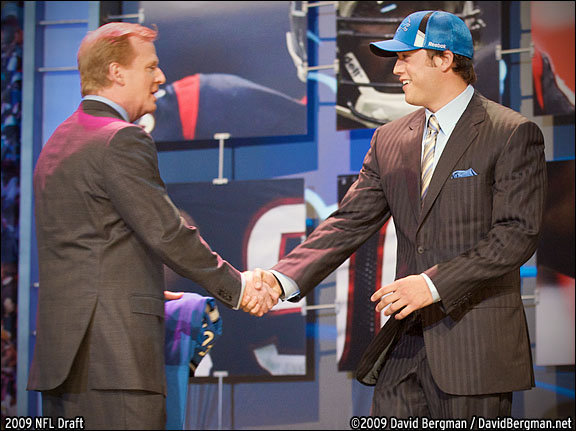
At times like these, you just shake your head. There’s nothing else I could have done. Before the second pick, (with only a few minutes between selections), I talked to my NFL contact, and he asked the commissioner to try to stay in the correct spot. He did it for #2 but pretty much stood anywhere he wanted for the rest.
The third pick was a player who was in his home town and not in the building, so we had a couple of extra minutes. I sent my assistant backstage to adjust the camera in the back and he was able to straighten it out.
I shot the rest of the draft (transmitting photos after every pick for the web site) and then collected all of my remotes.
Here is how it turned out.
Picks one and two (the most important ones) had a big part of the image blocked from the video guy’s bump. I was not happy.
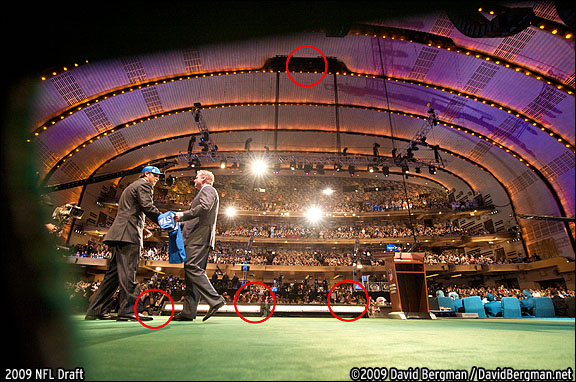
The red circles indicate where my four other cameras were placed. From left to right is the front remote, my standing position, D cove (in the ceiling) and my assistant.
The front remote made a few pics but was blocked quite often by the two Steadicam operators and various cord handlers working for ESPN, the NFL Network, and NFL Films.
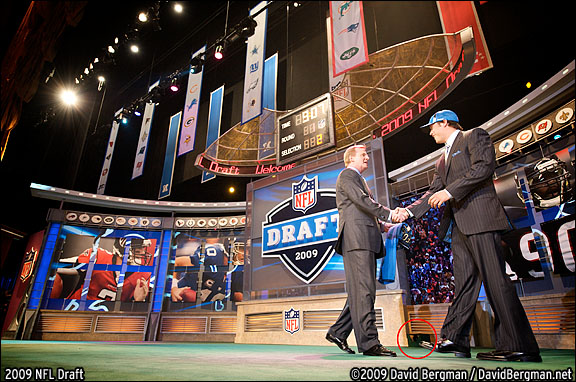
The red circle by Stafford’s foot shows my fifth camera at the back of the stage. The above three shots were all taken at the same time.
The overhead shot worked well, although even at one frame every five seconds, I missed a few “peak moments” like Stafford’s handshake with the commissioner. This image was about 3 seconds later, when they were already posing together with the Lions jersey.
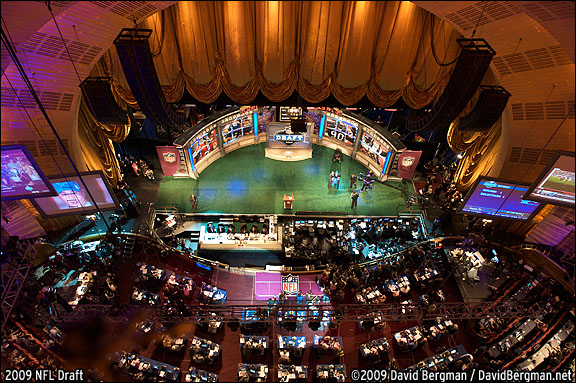
The overhead wound up shooting 952 frames over nearly 80 minutes before the card filled up. That got me through the first eight picks of the draft.
The good news is that, because I had five cameras shooting at all times, I still had a number of good images to choose from.
Sports Illustrated wound up publishing my shot of Stafford greeting the commissioner from my camouflaged remote. It was in the Leading Off section across two pages in the front of the magazine. They were able to crop in a bit to eliminate most of the part that was blocked by the box, although you can still see some of it in the top left.
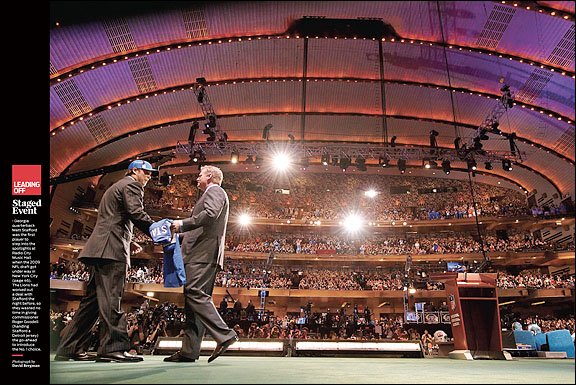
While everything didn’t go perfectly (does it ever?), I’m glad I spent the time and effort to cover myself. All that the readers see is the final image in the magazine. Unless you’re reading this blog, of course.
Now I’ve got to figure out what to do next year.